
When I was young, there was a sort of radicality in the way we thought about shopping, far from the actual crisis in Retail.
I still remember taking the train from my small village in the north of the Parisian suburbs just to go to the Virgin Megastore on the Champs-Élysées. Not because I needed something specific, but because I wanted to experience something.
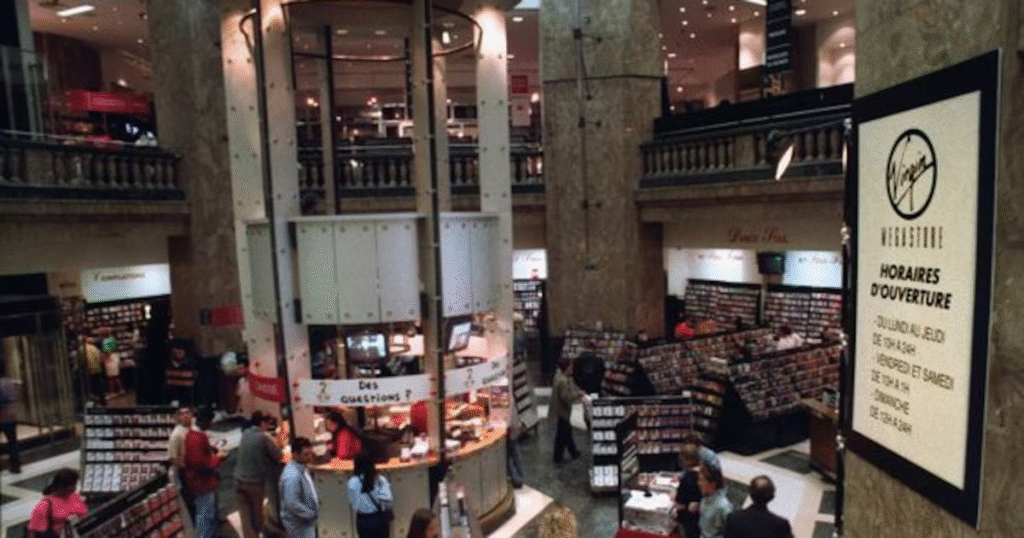
Virgin Megastore was, in many ways, a deeply European creation. It was designed for the city, not to be browsed in an impersonal mall. It mixed culture and commerce, books and vinyls, films and ideas/events: all under one roof. You could find a rare import CD from Japan or a limited French edition next to a pop single. Artists would come there at midnight to promote their new album. It was sometimes chaotic but sensory, and alive, typically a place where commerce was also curiosity.
That kind of retail is almost impossible to build today. Not because capital is lacking, but because the culture of risk has vanished. Stores became cost lines. Experience became a KPI. And retail, instead of inspiring desire, now optimises transactions.
Paradoxically, some of the most successful chains today (like Action in Europe) are the least digital. They have no sophisticated website, yet they draw crowds because they reintroduce unpredictability. They make you want to come back, not because they know you, but because you don’t know what you’ll find.
Retail failed, not because people stopped buying. It failed because it stopped being a place worth going to.
In the background, the payments industry quietly adapted to that same fatigue, turning simplicity into a service and complexity into a business model, taking advantage of this crisis in Retail.
The Myths That Hid the Crisis in Retail
We’ve been told that retail is dying because consumers have changed, but that’s a convenient half-truth.
Habits changed, the mindset didn’t : People still queue for limited sneakers, travel for good restaurants, and pay for experiences that feel exclusive.
Even the ultra-rich, those supposedly immune to economic cycles, are shifting.
As The Economist recently illustrated, their spending on services has soared while purchases of luxury goods have fallen sharply.
When people who can buy anything start chasing time and access instead of objects, it reveals something deeper: consumption didn’t die, it simply changed its coordinates.
The hierarchy of desire remains; only the form of ownership has evolved.
What really changed were the myths industry chose to believe, and potentially triggered this crisis in Retail.
Retail stopped asking what people wanted and started assuming they preferred abstraction over presence.
Myth 1 — Digital equals progress.
Retailers closed stores and chased “digital transformation,” turning physical presence into a liability instead of a strength.
According to McKinsey (2024), between 2019 and 2023, European retail turnover rose slightly in nominal terms (around +2 %) but declined in real value by roughly 1–2 %, showing that consumption didn’t disappear, only how success was measured changed
Margins tell a similar story. Industry reports from McKinsey, S&P, and EuroCommerce all indicate sustained margin compression since 2019: grocery EBITDA margins have slipped from approximately 6.9% to 6.2%, and most non-grocery retailers remain below pre-pandemic levels. Retailers responded not with reinvention, but with optimisation. They tried to defend their shrinking margins by leaning harder on technology and doubling down on digital.
And yet, 6 ou 10 of executives now report feeling “transformation fatigue,” caught in overlapping digital projects that fail to deliver meaningful uplift (Gartner). So, is this what we waited for when we said get digital now to the industry?
We’ve reached the point where you can walk into a store the size of a warehouse and still find nothing. Everything is “available online.” The shelves are half-empty, not because the space is lacking, but because the confidence is. Retailers fear holding stock, fear it won’t sell, fear being wrong.
While it’s true that overstocking kills margins, this also reveals a deeper loss: a complete misknowledge of who walks through the door. One of the keys to understanding this crisis in Retail.
The irony is that digital, which promised to “know” the customer, actually anonymised the relationship. We now have endless data, yet no sense of familiarity.
Across Europe, staff levels in stores have declined since 2019, and numerous surveys indicate a corresponding decline in customer satisfaction. Efficiency replaced empathy; no API can fill that gap.
The myth of progress was never about the consumer; it was about the narrative. Retail stopped asking what people wanted and started assuming they preferred abstraction over presence.
Myth 2 — Omnichannel equals value.
Synchronise everything, integrate every channel and somehow, margins will follow. Except they didn’t. Complexity replaced profitability.
Omnichannel was supposed to be the next frontier of retail maturity. The idea is that by connecting every touchpoint, we would finally understand and satisfy the customer. But what it really created was an illusion of control and fed the crisis in Retail.
Every checkout, every app, every loyalty layer was meant to “unify” the journey, yet in reality, it fragmented it further, adding interfaces, intermediaries, and dependencies. The promise of omnichannel was not simplicity, but the management of friction.
Behind the sleek dashboards, integrations became expensive invoices; APIs became a new Eldorado for some businesses. Retailers spent millions “connecting” systems that were never designed to speak the same language.
- European retailers continue to face margin compression since 2019, with grocery EBITDA margins slipping by about one percentage point
- Six in ten retail executives report “transformation fatigue”
- Cross-border retail activity declined by roughly 15–20% in 2023 as companies refocused on domestic markets.
Most omnichannel initiatives still fail to deliver sustainable ROI, largely due to integration and maintenance costs (McKinsey 2024).
Fewer than 40 % of retailers say their digital initiatives have produced measurable returns (Gartner 2023).
The rest built layers of connection that improved visibility, not desirability, meaning consumers learned to compare, not to care.
In the end, retailers integrated journeys that already worked, mistaking the map for the territory, and the metric for the meaning.
And while everyone talked about “seamlessness,” no one talked about sense.
What was the point of connecting everything if the experience itself was no longer compelling?
Omnichannel didn’t make retail stronger; it made it heavier. It taught merchants to believe that efficiency equals desire. The more fluid the process, the more value would appear. But the opposite happened: customers got convenience indeed, and merchants lost meaning.
Myth 3 — Data replaces the good old sense of commerce.
Retail stopped curating experiences and started optimising funnels. Stores became nodes in a logistics diagram rather than destinations in a cultural and local landscape. The crisis in retail also lies in the obsession with personas.
We began designing products, layouts, and entire brand identities for fictional consumers: perfect composites that never actually walk into a store.
Instead of observing people, we started modelling them. Instead of curating and offering a strong concept, we tried to predict the behaviours influenced by the progress of neuroscience.
But consumers remain human beings, and by design, they are anonymous, unfaithful, and contradictory.
They want security and personalisation at the same time; they seek belonging but resist being categorised.
That tension used to inspire creativity, but now it terrifies marketers obsessed with profiling and segmentation.
Curation embraces that unpredictability; Persona-driven strategy denies it.
And that’s how retail slowly lost its soul: by chasing profiles that don’t exist instead of creating places that make people want to exist there.
We built a retail ecosystem that measures everything, except desire, because this one cannot be measured rationally.
We no longer created stores for real people to explore; we built “journeys” for abstract personas to complete.
When the New Retail Became Old Too Fast
For a moment, D2C brands looked like the antidote for this crisis in Retail.
They spoke differently, looked fresh, and promised authenticity. For a while, I was excited by them too. But soon they all began to feel the same: carefully designed, algorithmically marketed, but emotionally empty.
They were born online, and marketing was their lifeblood. But Marketing isn’t Desire; it’s fuel that burns fast and expensively.
Without in-store presence or genuine sensory experiences, the attraction quickly faded. When they finally opened physical pop-ups to “reconnect with customers,” it was already too late: the thrill had been standardised.
Their margins didn’t collapse because of rents or staff but because of crazy acquisition costs, fed by cheap money from VCs.
Born online, they relied on constant paid visibility to exist. And when those costs exploded, the model imploded. Opening physical stores didn’t save them either; it only added another layer of expenses to an already fragile unit economics.
Meanwhile, the real survivors were those who ignored digital orthodoxy altogether: discounters and luxury houses. First thrived on competitive price and proximity (ultra good assets when inflation goes bonanza). The second, thriving on emotion and spectacle, arrived really late on the digital because of ultra ultra-comfortable margin. The safe, digitally “mature” middle vanished, squeezed between scale and soul.
And in that loss, something deeper became visible: retail had internalised the digital mindset so fully that even its rebellion looked like imitation. Everything was campaignable, trackable, and reversible.
We no longer created stores for real people to explore; we built “journeys” for abstract personas to complete.
When Global Retail Forgot Culture: Japan the counterexample
Another reason for the crisis in Retail, all outlets feel so bland today because we have standardised it to death.
Somewhere along the way, a global playbook emerged for how a store should look: same lighting, same layout, same scent, same playlist. We built a retail monoculture designed for scalability and erased the excitement of difference. But desire doesn’t scale.

One of the most vibrant retail cultures in the world today is arguably Japan’s, and resisting to crisis in Retail. Precisely because it resisted this globalisation. Tourists don’t go there to buy cheaper goods; they go to discover the specificity.
Japan’s domestic retail still represents roughly 80% of its total consumption, and many heritage brands like Muji or Shiro deliberately limit their international exposure. That restraint now drives cultural tourism. In 2024, inbound visitors spent ¥2.4 trillion on shopping, nearly 30% of total tourist spending in the country, one of the highest shares in the world.
Cross border commerce, an illusion as well?
Across Europe, many retailers have increased local sourcing over the past three years, a shift confirmed by EuroCommerce and BCG analyses, driven by supply-chain instability and higher transport costs..
And interestingly, Cross-border retail activity declined by roughly 15–20 % in 2023, as companies prioritised domestic profitability over global sameness. Retail globalisation quietly reversed: sameness simply stopped selling.
What’s striking is how this runs against the entire playbook of the payment industry, which still sells cross-border connectivity as progress.
While retailers return to local identity and proximity, payment schemes double down on global interoperability, a vision that increasingly serves the infrastructure more than the merchants.
The two are no longer aligned: retail is seeking roots, while payments keep chasing scale.
Europe lost a lot of its cultural retail long before the U.S. lost its malls. Japan, interestingly, never did.
By contrast, much of Western retail followed an Americanised template: shopping malls, global franchises, predictable layouts. We believed efficiency was the universal language of commerce. It wasn’t.
When everything looks the same, nothing feels worth discovering.
And perhaps that’s the most ironic part: the more we built global brands, the more we shrank their emotional geography. We forgot that curiosity, like culture, only exists in contrast.
The Payments industry no longer simplified payments; it learned to sell the management of its own complexity.
When Payment Joined the Illusion
Payments didn’t cause this crisis, but they certainly learned how to profit from it.
Over the past decade, acquirers and PSPs have been crushed by margin pressure. Over the past decade, merchant-acquiring margins in Europe have narrowed by roughly one-third, while compliance and fraud-management costs have risen sharply.
To defend their percentage-based revenue, they needed to add visible value, or at least the appearance of it. So they built complexity.
Payment economics explain part of the problem. Because scheme fees and infrastructure costs are largely fixed, the system rewards volume, not variety. The entire system rewards standardisation.
A retailer who wants to launch an unconventional model (a marketplace, a hybrid loyalty program, or an experiential subscription) instantly collides with pricing structures that assume uniformity. Every deviation becomes an exception to the process, and exceptions are expensive.
The message is clear: innovation is only efficient when it looks like everything else.
“Unified Commerce” a solution to a self created complexity
That’s how “unified commerce” became the perfect rhetorical trap.
When Adyen promise merchants the “single platform for all channels,” they sell the illusion of simplicity, a simplicity that exists only because complexity has been absorbed upstream and monetised downstream.
It’s not wrong; it’s just self-serving. The unification serves the infrastructure, not the merchant.
“Unified commerce” arrived as the perfect story: the promise of simplicity across channels.
But behind the scenes, each new “layer” (orchestration, tokenisation, analytics) was a new way to monetise the same transaction twice.
The industry no longer simplified payments; it learned to sell the management of its own complexity.
In short, if your base product no longer generates margin, you start selling the map to your own maze.
The outcome was predictable: an ecosystem that rewarded the illusion of unification while discouraging experimentation. Retailers paid for “seamless” systems that, in reality, only deepened their dependency.
When “Education” Meant Repression
I remember meeting retailers who wanted to create something new, ambitious, risky, and different.
And as a provider, I often had to tell them it wasn’t possible.
“Your expectations are too high.
The model doesn’t fit.
Try this instead.“
I said those things a hundred times. Not because I didn’t want to help, but because our matrix as a provider was rigid by design. The schemes we relied on were built to standardise, not to experiment.
Every time a retailer tried to push boundaries, the infrastructure pushed back.
We called it “educating the client.” But it wasn’t education, it was repression.
The industry framed compliance as wisdom and conformity as expertise. But underneath, it was fear: fear of risk, fear of error, fear of losing the margin that kept everything afloat.
Retail couldn’t reinvent itself because payments had already decided what was possible. And once you’ve defined what’s possible, desire dies quietly.
Desire Is Still the Real Currency
Retail isn’t dying; it’s disenchanted.
And payments, rather than helping restore meaning, became complicit in monetising fatigue.
Payment was meant to make commerce flow. Instead, it turned into a toll system, charging access to experiences it quietly helped dismantle.
If retail wants to recover, it doesn’t need another digital transformation. It needs to remember what made people take the train for an hour just to browse a store: the thrill of wanting something you didn’t yet know you wanted.
Because no matter how frictionless payment becomes, commerce has never been about speed or convenience. It has always been about desire , and that, still, is the most valuable currency we have.
(Edited on 10/11, some data provided were misleading or wrong. Spill the Tea on Payment does not support the wrong usage of data that could mislead information. It is one of our core promises, stay close to reality to describe phenomena. We corrected and fact-checked all data.)