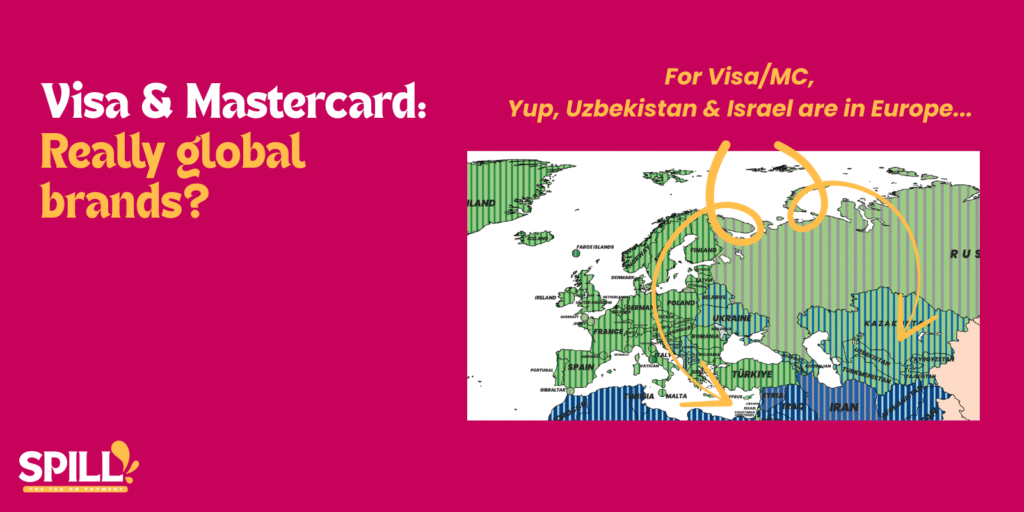
Visa and Mastercard like to sell this simply: they are both global brands. With one of their card, no barrier when it comes to spending your money. Well, if this story is seductive for consumers, it is not the case for the merchants. They sign a contract with the two networks via their partnering acquirers, usually accepting both brands. The reality is way more complex, political: Visa and Mastercard don’t even share the same map of the world. In a fast-changing world, where geopolitical issues take more and more space and have a visible impact on users, it is not a simple question of maps.
One world, two different maps
Visa covers 238 territories. Mastercard covers 232. At first glance, that sounds almost identical, but the devil lies in the details. If you look closer, 25% of Mastercard’s network doesn’t align with Visa’s. Therefore, the promise of real global brands suddenly becomes way more debatable. It also breaks a common (mis)conception in the payment industry: Visa and Mastercard are pretty the same. Obviously, not, and certainly not that seamless.
It has real implications for merchants. Transactions from the same territories can be processed differently according to the schemes’ vision of the world. The consequences are real:
- Fees → a transaction that looks “intra-regional” might be billed as “inter-regional”. The territories are not mapped in the same way by both networks.
- Compliance → obligations of control on transactions differ by schemes. Therefore, acquirers must impose different onboarding procedures, or transaction monitoring.
- Operations → mismatches complicate reporting, reconciliation, fraud monitoring, and chargebacks.
It is not only a technical fantasy from our favourite duopoly, but also a structural problem hidden beneath the promise that Visa and Mastercard are “global brands.”
Politics over geography
The mismatches, of course, are not random; they follow a business logic and sometimes a political one. The list of curiosity is long, but I wanted to give you a couple of examples to show you how geopolitical the vision of the map is.
Taiwan is not a territory recognised by the UN (United Nations), but both Visa and Mastercard treat it as an autonomous territory. So Taiwan will pay different interchange fees according to the cardholders. And, for those who say Taiwan belongs to China, it is not the case for Mastercard or Visa, the same for Hong Kong or Macao. All those territories are separate. Therefore, Chinese merchants will pay extra fees if the card is Taiwanese, Hongkongese or Macanese.
Or look at Russia: both schemes withdrew after sanctions. But Mastercard still recognises as a territory in its “Europe” region, exposing how scheme maps adapt to geopolitics. Still not clear if Russian cardholders cannot pay with a Mastercard, at least for Visa, it is clear, Russia is out.
👉 If you want to see all the mismatches, the maps, and the strategic framing, I detail them in the full case study. [Get the case study here]
Even tiny Vatican City gets different treatment depending on which scheme you look at. For one, it is an autonomous territory; for the other, it belongs to Italy. Of course, Merchants in Vatican City are not numerous. But still, Visa decided they could make a little bit more money.
One of the funniest examples is the -stan countries of Central Asia (Kazakhstan, Tajikistan, Kyrgyzstan, Uzbekistan, Turkmenistan). Mastercard considers them as “Europe”, but for Visa, it is “Middle East-Central Europe”. Obviously, neither category corresponds to a geographical reality. Israel is also in Europe.
The global acceptance isn’t neutral; it bends to politics and business priority before it bends to geography.
Why this matters
For merchants, the impact is straightforward. The more they go global, the more their operations get fragmented. Even if they use the same brand. Visa and Mastercard are not really global brands: different logic within can co-exist and complexify their payment processes. Although global acquirers tend to mitigate those frictions, they still represent :
- Hidden costs : merchants must pay according to the territorial logic of each schemes
- Inconsistent and unpredictable pricing: each transactions on each countries might vary according to scheme fees, interchange variations.
- Inconsistent acceptance, because issuers and acquirers will not process transactions the same way according to where they come from
- Unnecessary operational headaches, especially on reconciliations
It is even acute, when a payment business is trying to scale its operations. Suddenly, they understand outside of their territory or their regions, the way the network operates can be completely different, creating a hardship, even a lack of scalability vs their product capability. They must reprogram a whole set of product adaptation to fit the network’s expectation on one territory. Finding even a partner to help can be tricky.
Payment facilitators for example cannot have the same consistent acquirers accross territories, otherwise their acquirer and themselves can be sanctionned for not respecting the territory integrity of the schemes, that as you probably read, completely unilateraly decided by the scheme.
And for strategy teams in businesses, it raises a bigger question: if global schemes can’t always align, is there room for alternatives that win on clarity?
Alternatives to global brands are on the rise because they offer some promises that schemes cannot hold: an easier way to operate, a more predictable cost structure (not always cheaper), and sometimes less stringent financial requirements for onboarding. Those alternatives are not always local cards; they can be account-to-account-based networks, and the one with the most traction currently: the instant payment scheme.
Go deeper: the full case study
This blog is only scratching the surface. In my latest premium case study, I break down:
Strategic framing: what this means for merchants, acquirers, and the rise of alternatives.
Visa vs Mastercard coverage (238 vs 232 territories).
Where mismatches occur and how they affect fees, compliance, and operations.
Regional deep-dives (Europe, MEA, APAC, Americas).
Geopolitical flashpoints shaping scheme rules.
Real transaction examples that show how two schemes treat the same flow differently.